News and Updates
How to use ACRS sustainability scheme for Green Star
22-Jul-2026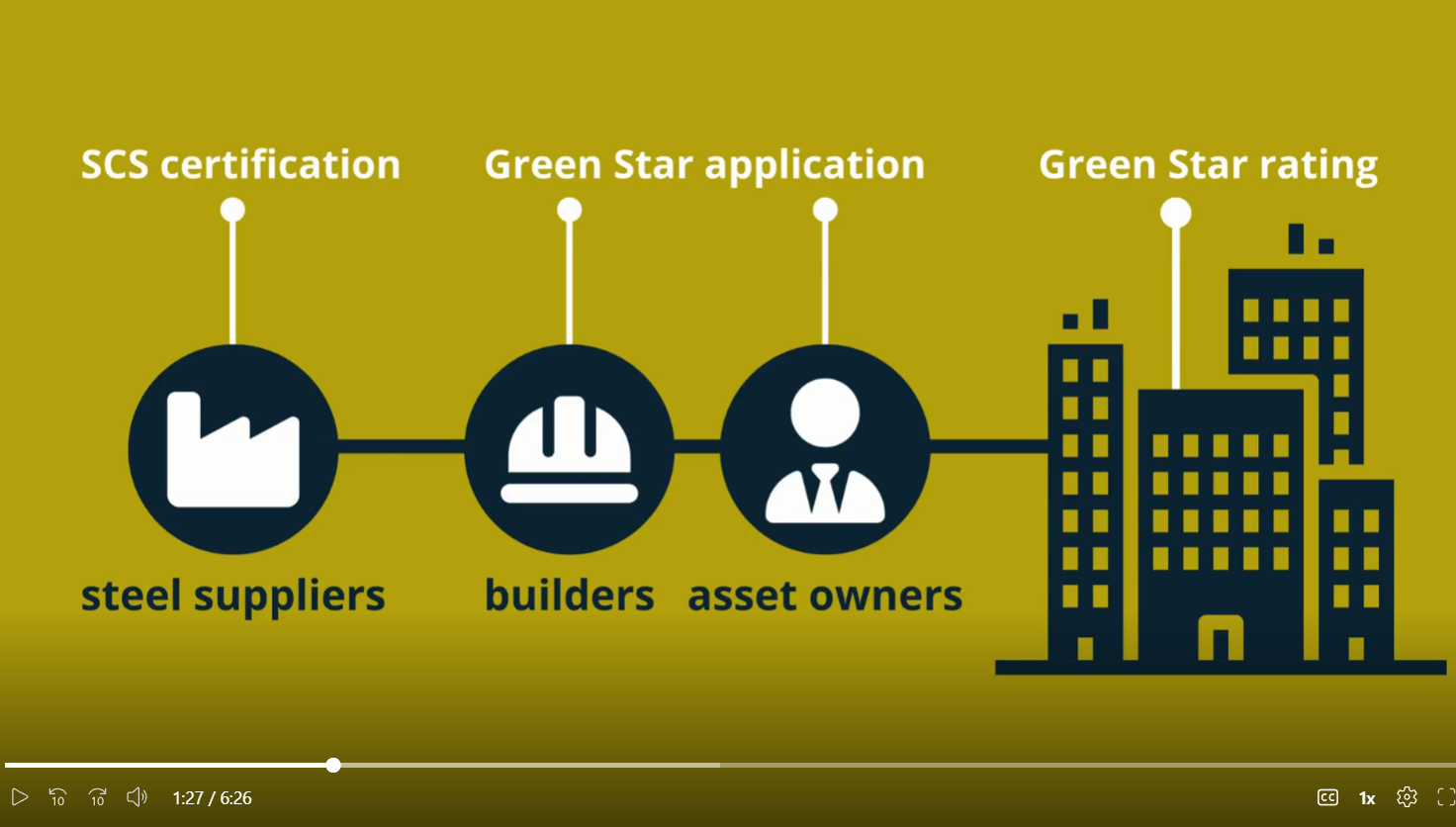
The Green Building Council of Australia (GBCA)’s Green Star rating system is used throughout ANZ to verify the environmental and social outcomes of buildings. ACRS Sustainable Constructional Steel (SCS) Certification is recognised by the GBCA’s Responsible Products program, which is used for Green Star credits.
The following video explains how Responsible Product initiatives such as ACRS’ SCS Scheme are used within Green Star for final points:
Understanding how steel contributes to a Green Star rating is not always straightforward. This new ACRS video makes the process much easier to follow. We explain how steel produced using processes certified under the ACRS SCS Scheme can contribute to Green Star points and how those points are calculated.
Green Star, the sustainability rating system developed by the Green Building Council of Australia (GBCA), awards projects points across a range of categories. The total determines whether a building achieves a four, five or six-star rating.
The new video focuses on Responsible Procurement and explains how Responsible Product Values are assigned to certified materials and entered into the Green Star Responsible Products Online Calculator. It takes viewers through the points system step by step, using practical examples to show how the amount and type of certified material used can contribute to the credits available.
Products the result of processes certified at any of the three levels of the ACRS SCS Scheme exceed Green Star’s Best Practice threshold. Level 1 certification provides a Responsible Product Value of 16, while Levels 2 and 3 provide a value of 21. Products resulting from ACRS SCS-certified processes can help unlock up to nine of the 13 points available under Responsible Procurement.
For project teams, asset owners, architects, builders, steel purchasers and Green Star assessors, it provides a clear introduction to a system that can otherwise be difficult to navigate.
Please note: the information and methods in this video are accurate at time of publication, but are illustrative only - the Green Star system is constantly updated and subject to ongoing changes.
Transcript:
Project teams, asset owners, builders and Green Star assessors often ask how ACRS’ Sustainable Constructional Steel Scheme can be used for the Green Building Council of Australia’s Green Star ratings.
As one of the leading steel certification schemes recognised under Green Star’s Responsible Products Framework, the SCS Scheme is used by steel buyers for project planning, procurement decisions and credit calculations.
This presentation will explain the relationship between ACRS’ SCS Scheme and Green Star ratings.
The Green Building Council of Australia is Australia’s trusted authority on sustainable buildings and communities. Green Star is the Green Building Council’s sustainability rating system, used to rate buildings, fit-outs and developments.
Green Star’s rating system certifies projects as responsible, healthy, resilient, and positive – and, like the ACRS SCS Scheme, aligns with UN Sustainable Development Goals and other leading global frameworks.
Green Star has similarities with other international programs, such as LEED in the US, BREEAM in the UK, and the European DGNB system.
Green Star is used by builders and owners who want a rating for a building. To achieve Green Star certification, a building is awarded points based on its performance across different categories. The total points determine its Green Star rating.
If it can achieve 15 or more points, it will get a four-star rating; 35 or more - a 5-star rating; 70 or more - a six-star rating. These ratings gain that building global recognition that its sustainability credentials are of a very high standard.
A project team will aim for a certain star rating. To do so they need to find ways for the building to achieve Green Star points.
Green Star has recently focused more on the sustainability of materials used during the construction phase of a building’s life – aka the embodied carbon. The rating system now actively rewards reducing upfront embodied carbon, primarily through the choice of materials used.
Project teams considering ways to get Green Star points through the reduction of upfront embodied carbon mostly look at ‘Responsible Procurement’ in the ‘Responsible’ category.
Responsible Procurement has four credit areas (Structure, Envelope, Systems and Finishes). These credits can be achieved by project teams using ‘Responsible Products’ (like ACRS SCS-approved steel) and can unlock up to 13 points in the Green Star Buildings program.
Responsible Product Credits are earned with Responsible Product Value points. RPV points are assigned to particular materials, like steel products, that are certified by recognised third-party initiatives.
A project team will often choose products that contribute most towards achieving these credits. They then input the amount of certified material used into the Green Star Responsible Products Online Calculator, where RPV points tally to achieve the particular credit being sought.
For example, under the Responsible Structure credit, three points towards a Green Star rating can be achieved if 50% of all the steel coming into a project (by cost) has a Responsible Product Value of at least 10. However, an additional two points can be achieved, if that is true AND another 10% of the steel coming in has an RPV of 15. This would give you a total 5 points from the Responsible Structure credit towards the project’s total points contributing to its Star rating.
Different recognised product certification initiatives confer different Responsible Product Values on products – even the same products!
A product’s RPV depends on its particular certification initiative, and specifically the level of that certification which the product has attained.
ACRS’ SCS scheme delivers higher RPVs overall than any other steel certification scheme currently available.
ACRS SCS Scheme has three levels. Products certified at any of the three levels offer ‘Best Practice’ maximum RPV points across all Responsible Product categories. Importantly, all SCS Scheme-certified products (at any level) exceed “Best Practice” i.e. an RPV of 15 or more.
Level 1 confers 16 points, and levels 2 and 3 confer 21 points, per certified product. Other steel schemes might convey 9 points at level 1 for example, and be limited to certain categories or offer partial credits.
So, 100% of product with ACRS SCS certification achieves maximum credits for a project team seeking to achieve both the three points for basic credit achievement, and the additional two points for ‘exceptional performance’, within the Responsible Structure category.
ACRS SCS-certified products alone can unlock up to 9 of the 13 points available under Responsible Procurement, towards a building’s Green Star rating.
Green Star has increased market demand for building products officially recognised as having better sustainability performance. And the ACRS SCS scheme is recognised by the Green Building Council of Australia as ‘best practice’ in responsible product sourcing.
When used in combination with other certified initiatives (covering non-steel products or systems), the SCS Scheme places a project in the strongest position to meet the relevant credit requirements and apply for a strong Green Star rating.
An ACRS-SCS-certified processor or trader can guarantee that every ton of their steel delivered will unlock the maximum number of Responsible Product credits possible for the highest contribution toward Green Star.
As a steel supplier, there are major advantages to getting your product certified by a top Green-Star-recognised market leader that is
- independent, with a not-for-profit model, mandatory 3rd party audits, and a separate and autonomous audit report assessment committee
- focused on transparency for recycling, carbon footprint and data measurement and ESG claims,
- globally-aligned and best practice.